

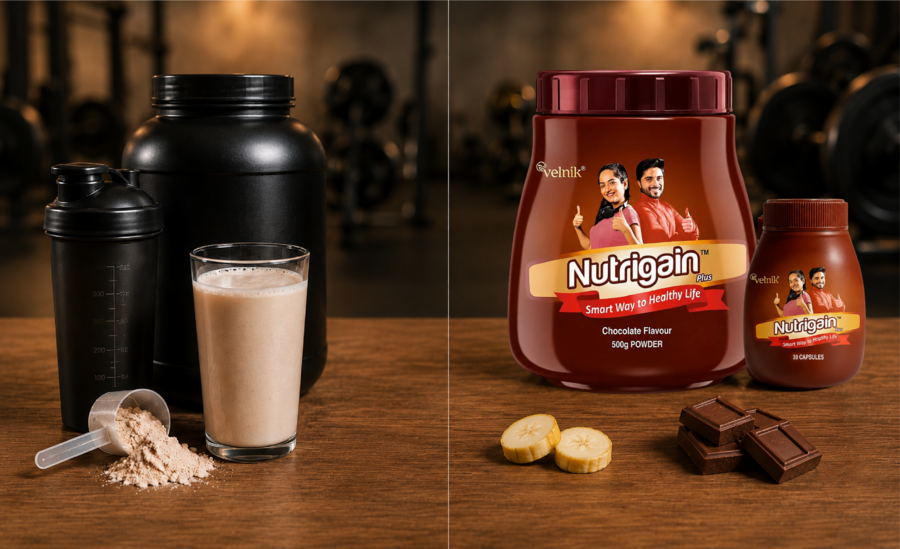
A protein shake and a weight-gain supplement may look similar when mixed with milk or water, but they serve different nutritional purposes. The biggest difference is not the powder itself—it is what the product is designed to contribute to your overall diet.
A conventional protein shake is mainly used to increase protein intake. A weight-gain product generally provides additional calories along with protein and other macronutrients, making it useful for people who find it difficult to meet their energy needs through regular meals.
Understanding this difference can help you choose a product based on your actual goal, whether that is increasing calorie intake, supporting muscle development, or simply making your daily nutrition more convenient.
Protein Shake vs Weight-Gain Supplement: The Key Difference
The easiest way to distinguish the two is to consider what you are trying to add to your diet.
A protein shake is primarily a convenient source of protein. It can be useful when meals do not provide enough protein or when you want an easy way to increase your daily intake.
A weight-gain supplement has a wider nutritional purpose. It is usually formulated to provide calories from a combination of carbohydrates, protein, and sometimes fats.
So, while both can contain protein, their priorities can be different:
Protein shake: mainly increases protein intake.
Weight-gain supplement: Generally increases calorie intake while also contributing protein and other macronutrients.
There is no universal rule about which one is better. The appropriate choice depends on what your existing diet is lacking.
Why More Protein Does Not Automatically Mean More Weight
Protein plays an important role in maintaining and developing muscle, but protein alone does not determine whether your body weight increases.
Your total energy balance matters too.
If you regularly consume less energy than your body uses, adding a protein-focused shake may increase your protein intake without providing enough additional energy to support weight gain.
This is one reason people sometimes find that simply adding protein powder does not produce the result they expected.
Someone who already eats enough protein but struggles to consume sufficient calories may have a different nutritional need. In that situation, a calorie-containing product may be more practical.
The objective should therefore be to identify the gap in your diet before deciding which supplement to use.
What Does a Weight-Gain Supplement Usually Provide?
A weight-gain product can combine several nutritional components in one serving.
Depending on the formulation, it may provide the following:
- Calories
- Protein
- Carbohydrates
- Fats
- Vitamins and minerals
- Other nutritional ingredients
This makes it different from a product designed primarily around protein.
For someone who has a small appetite or finds it difficult to eat large meals, a weight gain powder can offer a convenient way to increase daily energy intake.
However, products can vary substantially. Two supplements marketed for the same purpose may have very different calorie counts, protein levels, carbohydrate sources, serving sizes, and ingredient profiles.
That is why the nutrition label is more important than the product category alone.
When Is a Protein Shake a Better Fit?
A protein shake may be a sensible choice when your overall calorie intake is already adequate but your protein intake is falling short.
For example, it may suit someone who:
- Gets enough calories from regular meals
- Wants a convenient source of protein
- Does resistance training
- Prefers a lower-calorie supplement
- Has difficulty reaching daily protein targets through food
In this situation, adding a high-calorie product may not solve a genuine nutritional problem.
The important question is not simply, “Do I need a supplement?”
It is:
“What am I currently not getting enough of from my diet?”
That answer can help determine whether a protein shake or another type of supplement makes more sense.
When Can a Weight-Gain Supplement Be Useful?
A weight-gain supplement may be useful when increasing food intake is the main challenge.
Some people find it difficult to eat enough because of a low appetite, demanding schedules, frequent physical activity, or simply because consuming large meals is uncomfortable…
A calorie-containing shake can be easier to consume between meals than another full plate of food.
A muscle gain supplement can therefore function as a convenient addition to a regular eating pattern.
It should not, however, be viewed as a shortcut to healthy weight gain. Your overall diet still matters, and the nutritional quality of the rest of your meals should not be overlooked.
Weight Gain Is Different From Muscle Gain
Increasing body weight and increasing muscle mass are not identical goals.
Body weight can change because of muscle, body fat, glycogen, water, and other factors. Therefore, seeing the number on the scale rise does not automatically mean that muscle has been gained.
If your goal is to build muscle, nutrition needs to work together with resistance training.
A muscle gain supplement can help support your nutritional intake, but a supplement cannot provide the training stimulus that encourages muscle adaptation.
A complete approach generally involves:
- Sufficient energy intake
- Adequate protein
- Progressive resistance training
- Balanced carbohydrate and fat intake
- Adequate sleep
- Consistent recovery
This is why a product should be considered part of a broader plan rather than the entire solution.
What Is a Mass Gainer and How Is It Different?
A mass gainer powder is generally designed to provide a relatively high amount of calories along with protein and other macronutrients.
The term “mass gainer” is commonly used for products aimed at people who want to make it easier to increase their overall energy intake.
However, the name alone does not tell you how much nutrition a product actually provides.
When comparing different options, look at:
- Calories per serving
- Protein per serving
- Carbohydrates
- Fat
- Serving size
- Ingredient sources
- Added sugars
- Allergens and dietary considerations
A product with a large serving size may appear more impressive on the label, so comparing products based on their actual nutritional contribution is important.
Is an Ayurvedic Weight Gainer Different?
An ayurvedic weight gainer generally refers to a product developed around an Ayurvedic or herbal formulation approach and marketed for people seeking support for healthy weight gain.
The Ayurvedic positioning is only one part of the evaluation.
You should still look at the complete ingredient list, nutritional information, serving instructions, manufacturer information, and quality details before deciding whether the product is suitable for you.
It is also important to distinguish traditional formulation approaches from guaranteed outcomes. A product should not be assumed to produce rapid or dramatic weight gain simply because it is described as Ayurvedic.
A sensible approach is to consider the product alongside your diet and lifestyle rather than expecting the supplement to work independently.
Understanding Ayurvedic Weight Gain Powder
An ayurvedic weight gain powder offers a powdered format for people who prefer to mix their supplement into a beverage or incorporate it into their daily nutrition routine.
The powder format can be convenient, especially for people who find drinking additional nutrition easier than eating another large meal.
But convenience does not tell you whether a product is nutritionally appropriate.
Before choosing one, check:
- Calories per serving
- Protein content
- Carbohydrate content
- Fat content
- Ingredients
- Serving size
- Dietary suitability
- Manufacturer information
This helps you determine whether the product actually complements your nutritional needs.
What About Herbal Weight-Gain Capsules?
Powders are not the only products marketed for weight gain. Some people prefer capsules because they are portable and require no preparation.
Herbal weight gain capsules generally contain selected herbal ingredients rather than providing the same quantity of calories and macronutrients that can be found in a calorie-dense powder.
That distinction is important.
If your primary challenge is not consuming enough calories, capsules may not provide the same practical nutritional contribution as food or a calorie-containing drink.
Someone searching for capsules for weight gain should therefore look beyond the product format and understand what the capsules are actually designed to provide.
Powder, Shake, or Capsules: Which Format Should You Choose?
The best format depends on your objective.
| Format | Primary Consideration | May Suit |
|---|---|---|
| Protein shake | Convenient protein | People who need more protein |
| Weight-gain powder | Calories plus macronutrients | People who struggle to eat enough |
| Weight gain shake | Easy liquid nutrition | People who prefer drinks |
| Capsules | Convenient delivery | People who prefer capsules |
| Tablets | Simple dosage format | People who prefer tablets |
For example, someone looking for additional protein may not need a high-calorie product. In contrast, someone searching for a powder to gain weight may be looking for an easier way to increase daily energy intake.
The product format should follow the nutritional need—not the other way around.
How to Choose a Weight-Gain Supplement
Choosing a supplement becomes easier when you focus on the information behind the marketing.
Start with calories
If increasing body weight is your goal, check how much energy the product actually provides per serving.
Do not assume that every product labelled as a gainer is automatically high in calories.
Check the protein content
If muscle development is part of your goal, protein remains an important consideration.
Look at the amount provided in a complete serving and consider how it fits into your overall diet.
Examine carbohydrates and fats
Carbohydrates and fats contribute energy and can significantly change the calorie content of a product.
A well-formulated weight gain formula should be assessed according to its complete nutritional profile rather than one ingredient.
Read the ingredient list
The front of a package is designed to communicate marketing messages quickly. The ingredient list gives you a much clearer picture of what you are actually consuming.
Look for transparent ingredient information and be aware of allergens or ingredients that may not suit your dietary requirements.
Compare serving sizes
A product may appear to contain a large amount of protein or calories until you notice that the stated serving requires several scoops.
Always consider the complete serving when comparing products.
Consider your individual circumstances
Your age, activity level, dietary pattern, allergies, medications, and health status can all affect whether a particular supplement is appropriate.
If you have unexplained weight loss, an existing health condition, or other concerns about gaining weight, consult a qualified healthcare professional.
Can a Weight-Gain Product Replace a Meal?
A supplement should not automatically be considered a replacement for a balanced meal.
Whole foods can provide protein, carbohydrates, fats, fibre, vitamins, minerals, and many other nutrients as part of a varied diet.
A weight gain drink can be useful when you need additional nutrition, but it should generally complement your meals rather than become the foundation of your diet.
For example, a balanced eating pattern can include:
- Protein-rich foods
- Whole grains and other carbohydrate sources
- Fruits and vegetables
- Nuts and seeds
- Dairy or suitable alternatives
- Healthy sources of dietary fat
A supplement can then be used to help fill a specific nutritional gap.
Can You Gain Weight Without Supplements?
Yes.
Supplements are not essential for gaining weight. A sufficiently nutritious diet can provide the energy and nutrients required to increase body weight.
For some people, however, eating enough food every day can be difficult. In those cases, a supplement may provide a convenient way to increase intake.
The key distinction is that a supplement is a tool—not a requirement.
If your diet already provides everything you need, adding another product may offer little practical benefit.
Can Weight-Gain Supplements Help With Muscle Growth?
They can support the nutritional side of muscle development, particularly when they help you meet energy and protein needs.
However, taking a muscle growth supplement does not automatically cause muscle growth.
Muscle development requires an appropriate training stimulus, sufficient nutrition, and recovery.
This is also why people considering muscle gain powder or other muscle-focused products should look at their complete training and nutrition routine rather than relying on the supplement alone.
Common Mistakes People Make When Trying to Gain Weight
Eating randomly instead of following a consistent routine
Simply adding high-calorie foods without considering overall nutrition can make it harder to maintain a balanced diet.
Choosing a product only because it says “gainer”
The name does not reveal the complete nutritional profile.
Focusing only on the number on the scale
Weight gain does not tell you whether the change is primarily muscle, fat, water, or other body components.
Ignoring resistance training
If your goal includes muscle development, training is an important part of the process.
Expecting immediate results
Sustainable changes generally require consistency rather than overnight transformation.
Taking several products without checking their ingredients
Combining multiple supplements can result in unnecessary overlap between ingredients. Always review the labels before combining products.
Weight-Gain Supplements: Powder vs Capsules
Powders and capsules can have very different roles.
A powder can deliver meaningful quantities of calories, protein, carbohydrates, and fats in a single serving. Capsules are generally more concentrated around specific ingredients and are not usually designed to provide substantial energy.
For that reason, weight gainer capsules should not automatically be treated as an alternative to a calorie-containing powder.
Likewise, people looking for muscle gain capsules should first determine whether they need additional calories, protein, or another specific nutritional component.
The most useful format is the one that addresses the actual gap in your diet.
Frequently Asked Questions
What is the main difference between a protein shake and a weight-gain supplement?
A protein shake is generally focused on increasing protein intake, while a weight-gain supplement usually provides additional calories along with protein and other macronutrients. The exact nutritional profile varies by product.
Is a weight gainer better than a protein shake?
Neither is automatically better. A protein shake may be more appropriate when you need additional protein, while a weight gainer may be useful when you struggle to consume enough total calories.
Does a weight-gain supplement build muscle by itself?
No. It can support your nutritional intake, but muscle development also depends on resistance training, adequate nutrition, and recovery.
What is an ayurvedic weight gainer?
An ayurvedic weight gainer is generally formulated around an Ayurvedic or herbal approach and marketed to support weight-gain goals. Its suitability depends on its specific ingredients and nutritional profile.
Is an ayurvedic weight gain powder suitable for everyone?
Not necessarily. Products can contain different ingredients and nutritional components. Check the label and consider your individual dietary and health circumstances before using one.
Are herbal weight gain capsules the same as a weight-gain shake?
No. A shake or powder can provide calories and macronutrients, whereas capsules generally contain smaller quantities of selected ingredients. They can therefore serve different purposes.
Are capsules for weight gain better than powder?
There is no universal answer. Capsules may be convenient, but a powder can generally provide substantially more calories and macronutrients per serving. The better choice depends on your nutritional objective.
What should I look for in a weight gain powder?
Check calories, protein, carbohydrates, fats, serving size, ingredients, allergens, added sugars, and manufacturer information. Compare the complete label rather than relying on marketing claims.
Can I take a weight-gain supplement every day?
That depends on the product and your individual dietary needs. Follow the manufacturer’s directions and seek professional advice if you have specific health concerns or dietary requirements.
Can I gain weight without using a supplement?
Yes. A balanced diet can provide the calories and nutrients needed for weight gain. Supplements are mainly useful when they make it easier to meet nutritional requirements.
Is a mass gainer powder the same as a weight-gain powder?
The terms are often used for similar products, but formulations can vary considerably. Always compare the nutritional information and ingredients instead of assuming two products are identical.
Are weight-gain tablets the same as weight-gain supplements?
“Weight gain tablets” is a broad product description and does not indicate a particular nutritional composition. Tablets may contain very different ingredients from calorie-containing powders or shakes.
Final Takeaway
A protein shake and a weight-gain supplement may share some ingredients, but their purpose can be very different.
A protein shake is primarily a convenient way to increase protein intake. A weight-gain product is generally intended to add calories along with protein and other macronutrients, which can be useful when eating enough food is difficult.
The same principle applies when comparing powders, shakes and capsules. An ayurvedic weight gainer, an ayurvedic weight gain powder, and herbal weight gain capsules can all be marketed toward similar goals, but their formulations and nutritional contributions may be very different.
The smartest way to choose is to start with your diet. Identify whether you need more protein, more calories, or both. Then compare products based on their actual ingredients and nutrition information.
A supplement can make a well-planned diet more convenient, but it should not replace the fundamentals of good nutrition, appropriate physical activity, adequate recovery, and consistency.