
There’s a peculiar experiment you can try at almost any gym.
Find someone who has been lifting weights for months. Ask them to flex their biceps. Then ask them how much their curl weight has increased since they started.
You might hear that they can lift twice as much as before. Maybe even more.
Now comes the interesting question: if their strength has improved so dramatically, why don’t their arms look twice as big?
Welcome to one of the strangest misunderstandings in fitness. We tend to imagine muscle growth as a straightforward transaction: lift heavier weights, collect bigger muscles. But the human body doesn’t operate like a vending machine.
You can become stronger without seeing the size you expected. You can spend hours training your arms without giving them the stimulus they need. And you can buy products marketed for weight gain while overlooking the very thing that determines whether your body has enough resources to grow.
So let’s stop treating small arms as a problem that needs another exercise or another supplement.
Instead, let’s examine the contradictions that make arm growth so confusing.
The Biceps Paradox: Why Can You Lift More Without Looking Bigger?
Imagine two photographs of the same person, taken six months apart.
In the first, they’re struggling with a pair of dumbbells. In the second, they’re lifting substantially more weight with better control.
You would expect the second photograph to reveal dramatically larger arms.
Sometimes it does. Sometimes it doesn’t.
That’s because strength is a skill as well as a physical quality. As you train, your nervous system becomes better at coordinating movements and recruiting muscles. You learn the technique, become more efficient, and gain confidence with the exercise.
These improvements can happen before substantial changes in muscle size become obvious.
There’s another complication: the weight printed on a dumbbell doesn’t tell the whole story. Someone swinging a heavy weight with limited control isn’t necessarily providing a better muscle-building stimulus than someone using a lighter weight with controlled, challenging repetitions.
The lesson isn’t to abandon heavy lifting. It’s to stop treating the number on the dumbbell as a complete report card.
Your strength tells you how your performance is changing. Your measurements and photographs help you understand how your appearance is changing. Neither measurement should be expected to tell the entire story on its own.
Your Arms Have a Public Relations Problem
Consider how people usually judge their arm size.
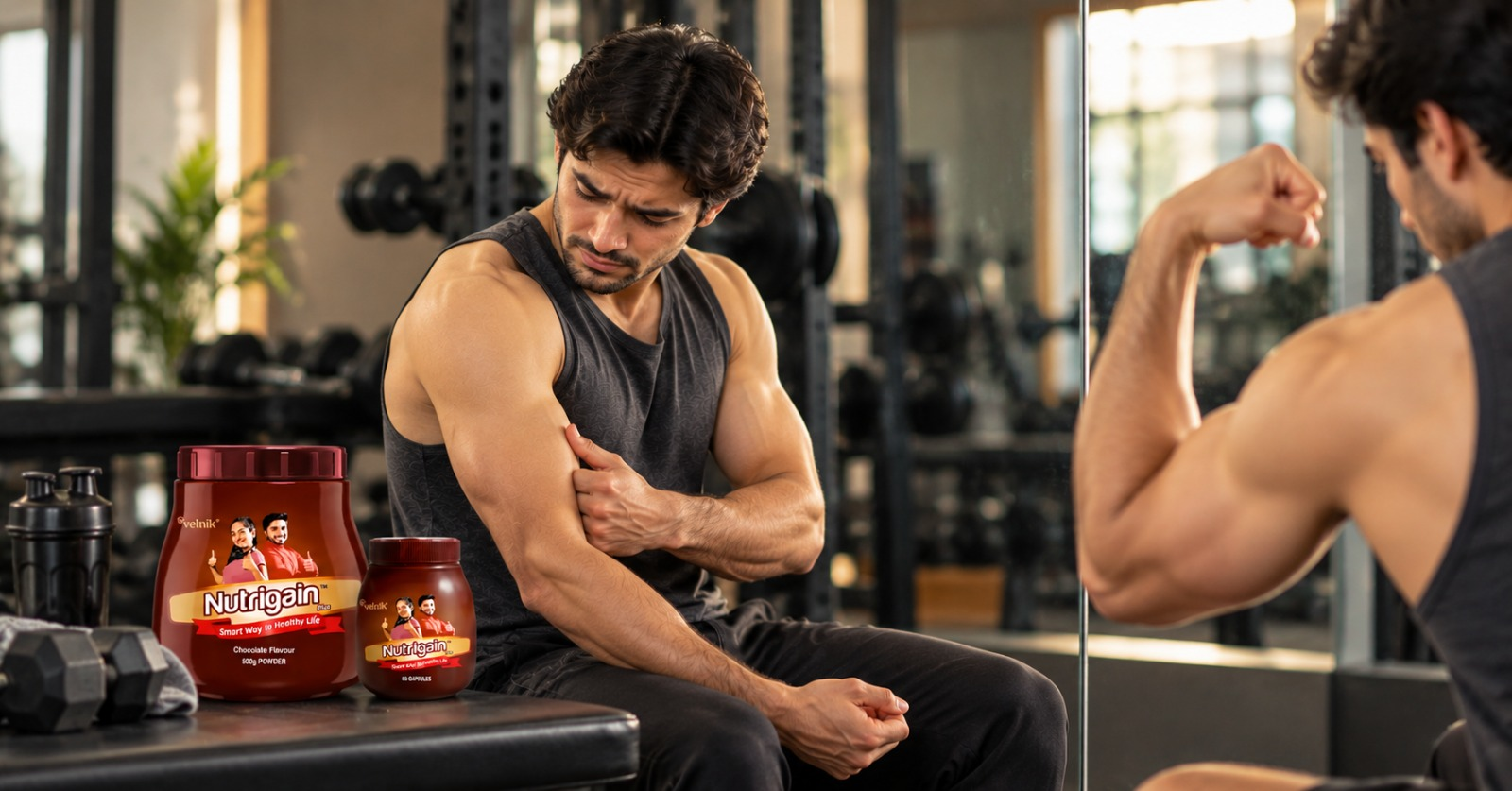
They flex in front of a mirror, examine their biceps from the side, and decide whether their workouts are working.
But that little ritual has several flaws.
First, the angle changes everything. Your arms may look fuller when your elbow is bent and your shoulder is positioned differently.
Second, a workout temporarily changes how your muscles appear. Increased blood flow and fluid shifts can create a fuller look that fades afterwards.
Third, you’re looking at yourself so frequently that gradual changes can become difficult to notice.
Your arms are essentially being reviewed by a critic who sees them every day, uses inconsistent lighting, and expects a dramatic transformation every time.
Not exactly an unbiased assessment.
Try replacing daily mirror checks with a simple comparison: take relaxed photographs under the same conditions and measure your upper arms consistently. Review the results over several weeks rather than judging individual days.
You may find that progress is easier to recognise when you’re not relying on memory and mood.
And if your measurements remain unchanged over a longer period, you’ve uncovered something important: your current approach may need adjusting.
The Forgotten Half of Your Upper Arm
There’s a reason a person can perform curls for months and still feel that their arms lack overall thickness.
The biceps receive a remarkable amount of attention. They have their own poses, their own gym conversations, and enough exercise variations to fill an entire workout playlist.
The triceps rarely receive the same enthusiasm from beginners.
Yet the triceps occupy the back of the upper arm and contribute substantially to its overall size. The brachialis, which lies beneath the biceps, also contributes to upper-arm thickness.
This means your favourite curl variation isn’t responsible for the entire appearance you’re trying to create.
Think of it as designing a room by focusing exclusively on one wall. You might make that wall look fantastic, but the room as a whole depends on the rest of the design.
A balanced training plan should give appropriate attention to both biceps and triceps, while including other upper-body exercises that support overall development.
You don’t need a workout containing 15 different arm exercises. You need a manageable programme, sound technique, suitable training volume, and a way to progress over time.
The real question isn’t how many curls you can squeeze into a session. It’s whether your overall training is designed for the result you actually want.
The Calorie Detective: Where Did Your Muscle-Building Fuel Go?
Let’s look at a different kind of mystery.
You train hard four or five days a week. You walk to work, climb stairs, run errands, and spend much of your day moving around. You eat three meals and genuinely feel that you’re eating a lot.
Yet your body weight hasn’t changed for months.
Where is the extra fuel for building muscle supposed to come from?
Your body needs energy to maintain its normal functions, support everyday activity, and recover from training. If you’re consistently consuming less energy than you need, gaining muscle can become more difficult.
This is particularly relevant if you’re naturally slim or trying to gain weight.
The tricky part is that appetite isn’t a measuring instrument. Feeling full after dinner doesn’t tell you whether you’ve consumed enough energy across the entire day.
Rather than immediately adding a supplement, examine your normal eating pattern. Are meals frequently skipped? Are portions consistent? Does your activity level leave you needing more food than you realise?
If your goal is to gain weight and your weight remains stable, a modest increase in calorie intake may be appropriate.
A weight gain supplement can be useful when regular meals don’t provide enough energy, but it should solve a specific nutritional problem rather than become a substitute for understanding your diet.
If you struggle to gain weight despite consistently eating enough, or experience unexplained weight loss, consult a healthcare professional to investigate possible underlying causes.
The Fitness Industry’s Favourite Plot Twist: The Product Isn’t the Plan
Search for ways to build muscle and you’ll quickly discover an entire universe of powders, drinks, capsules, and formulas.
Every product seems to offer a different answer to the same question: how can you get bigger?
But a supplement is useful only when you understand what it contributes to your routine.
Let’s separate the marketing from the practical considerations.
Mass gainer powder: convenience in a container
A mass gainer powder usually supplies concentrated calories from carbohydrates and often includes protein. For someone who struggles to consume enough food, this can make meeting daily energy requirements more convenient.
But convenience doesn’t automatically translate into muscle growth.
If you already consume enough calories and protein, adding a high-calorie shake may not be necessary. If you consistently eat too little, a suitable product might help bridge the gap.
The sensible decision depends on your diet, not on how impressive the packaging looks.
Compare calories, protein, added sugar, serving size, ingredients, and cost. A homemade smoothie made with milk or a suitable alternative, oats, banana, and peanut butter may also provide a practical source of energy.
Weight gain drinks: when drinking is easier than eating
A weight gain drink may be helpful for people who find large meals difficult to manage.
Its role is straightforward: provide nutrients and energy that contribute to your overall intake.
It cannot determine where your body stores energy or guarantee that your arms will grow. That depends on your broader nutritional situation, training, and individual response.
Muscle gain capsules: the convenience question
Products marketed as muscle gain capsules or muscle growth capsules can contain a wide range of ingredients, including vitamins, minerals, and herbal substances.
The name alone reveals very little about their effectiveness.
Correcting a genuine nutrient deficiency can help address a nutritional problem, but taking extra nutrients when you already get enough doesn’t automatically increase muscle size.
Be cautious of products promising rapid muscle growth without training or providing unclear ingredient information. Consider independent quality testing and consult a qualified healthcare professional if you have concerns about safety or interactions with medicines.
Natural weight gainer supplements and Ayurvedic formulations
A natural weight gainer supplement may appeal to people who prefer particular ingredients, while an ayurvedic weight gain powder may interest those who favour traditional formulations.
Neither label guarantees effectiveness.
Evaluate the actual ingredients, nutritional contribution, manufacturing quality, and evidence behind the claims. Herbal products can interact with medicines, and poor manufacturing controls can create safety concerns.
The same scrutiny applies to any weight gain formula. What matters is what it contains, whether it’s suitable for you, and whether it addresses a genuine need.
Here’s the point worth remembering: supplements can help supply nutrients or calories. They cannot replace a training programme that challenges your muscles appropriately.
The Muscle-Building Calendar Doesn’t Care About Your Deadline
One of the most frustrating aspects of training is that progress rarely follows the schedule you create in your head.
You might decide that three months is enough to build visibly bigger arms. You mark the date, follow your programme, and expect your reflection to cooperate.
But muscle development isn’t a deadline-driven project.
Your starting muscle mass, training experience, genetics, nutritional intake, recovery, and consistency all influence your rate of progress. Beginners may notice substantial improvements in strength before visible changes in size become apparent.
And social media complicates matters by showing you selected photographs without revealing every detail of the person’s starting point or training history.
The solution isn’t to lower your expectations until you stop caring about progress. It’s to measure the right things over a realistic period.
Record your workouts. Track your body-weight trend if gaining weight is your goal. Take consistent photographs and measurements.
If your performance is improving but your appearance changes slowly, you have information to work with. If both performance and measurements remain stagnant, it may be time to review your training, nutrition, or recovery.
Progress is easier to manage when you treat it as something to investigate rather than something you must force by a particular date.
A Different Way to Approach Your Next Month at the Gym
Instead of adding more exercises, buying several supplements, and changing your diet overnight, run a small experiment.
For the first week, record your normal workouts and eating habits. Establish your starting point.
During the second week, examine whether your food intake supports your goal. If you’re trying to gain weight, pay attention to your overall calorie intake and protein sources.
During the third week, review your programme. Are you training both biceps and triceps? Are your exercises challenging enough? Are you improving your performance while maintaining proper technique?
During the fourth week, compare your records. Look at strength, body weight, and measurements together instead of expecting one number to explain everything.
Four weeks won’t guarantee visibly bigger arms. It can, however, help you identify patterns that have been difficult to see while repeating the same routine.
If you’ve been consistent for months without meaningful progress, consider getting your programme and nutrition assessed by a qualified trainer or registered dietitian.
The Real Mystery Was Never Your Arms
When your arms look smaller than expected, it’s tempting to search for a missing exercise or a product that promises faster results.
But the answer is rarely as simple as adding another set of curls or buying another tub of powder.
You might be stronger because your technique and coordination have improved. Your arms might look different because of lighting and temporary changes after exercise. Your training might neglect part of the upper arm, or your food intake might not support the weight gain you’re aiming for.
Each possibility requires a different response.
That’s why the most useful question isn’t, “What can I take to make my arms bigger?”
It’s, “What does my current progress tell me about what needs to change?”
Start there. Measure what matters. Adjust your approach based on evidence, and give your body time to respond.
Because the fastest way out of a fitness guessing game isn’t another promise. It’s finally understanding the game you’re playing.